Relationship between the air-sea gas transfer velocity and turbulence
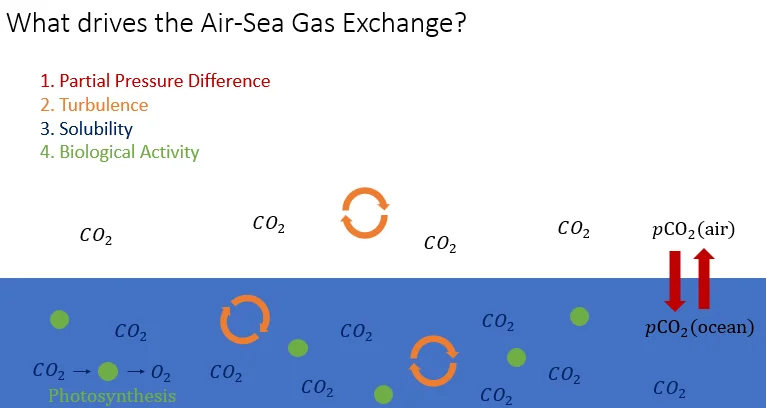
Air-sea gas exchange is often described by the gas transfer velocity k, which can be parameterized as a function of wind speed. While these empirical parameterizations are frequently used, it is acknowledged that there are additional physical, biological, and chemical drivers of air-sea gas exchange. We conducted coincident eddy covariance (EC) and turbulent kinetic energy dissipation rate (ε) measurements by an upwardly-rising microstructure profiler in the Labrador Sea. Based on these measurements and using the small-eddy model, we parameterize k as a function of surface ε. While the results generally agree with k from the eddy covariance measurements of the air-sea CO₂ flux, there are deviations observed in an algal-rich cold freshwater eddy in the Labrador Sea.
Contact

Jun.-Prof. Dr. Leonie Esters Junior professorship
Meteorology
1.010
Auf dem Hügel 20
53121 Bonn

Simon Hauser PhD student
Meteorology
1.016
Auf dem Hügel 20
53121 Bonn