Bachelor of Science
Meteorology and Geophysics
Meteorology and geophysics – two disciplines within earth sciences with a strong physical and mathematical focus – concentrate on recording, analysing and predicting physical events and processes within the Earth system. Combining both disciplines makes it possible to model significant exchange processes between the atmosphere, ocean and solid earth, and to formulate and address issues in current climate and environmental research.
Offers for first-year students
Enrolled, and what now? Make use of offers even before the start of lectures and become familiar with the systems for students!
- One account for everything: Unlock your Uni ID for the University of Bonn systems
- The communication channel is email: set up your university email account, check it daily and use it for study-related matters
- Get to know the BASIS examination system: personal study account with all services, exam registration and deregistration, study planner, course catalogue & documents
- Join courses on the eCampus learning platform: links can be found in the BASIS course catalogue
- Attend the physics preparatory course and complete the online course Fit4Math . Make use of the Fit4Math Learning Center!
- First-year student week by the mentorate and MuG student council before winter term: exciting programme to start your university life. Please register to be part of the first-year student week at the council website.
- First-year student welcome and café: Wed, April 14, 2026, at 13:15 in lecture hall Auf dem Hügel 20: information from academic advising and get together with students and lecturers - a must-attend!
- Special offer: "How to...?" mentorate programme starting Thu April 16 from 10:30 in SR MA176, join the eCampus course and stay tuned!
- Repetition "No fear of Uni maths!" Wed 16:00 computer scence room MA176. Additionally, use the Fit4Math eCampus online course.
- Maths and Physics learning centre: especially for Ex 1, 2, 3 and Maths 1, 2, 3, experienced tutors help you every afternoon - don't miss it!
Take advantage of the offers and network with like-minded people: we are happy to support you in successfully completing your studies!
Course content, modules, organization, formalities
Examination regulations govern your rights and responsibilities. But what does that mean in concrete terms? Whether you have questions about exam registration, elective modules, Erasmus, or bridging courses for admission to the Master degree program, we are here to help and advise, so you can study without worries!
Course content and structure
The admission-free Bachelor degree program in Meteorology and Geophysics deals with the mathematical and physical observation, analysis and prediction of the Earth system. The content is taught in modules on atmospheric physics, climatology, geophysics, measurement technology and remote sensing, based on the fundamental tools of higher mathematics and experimental physics.



Enrolment, admission, eligibility
Enrolment takes place online at the University of Bonn Student Registry from 10 June to 30 September (recommended) for the winter semester or from 10 December to 31 March for the summer semester.
Special requests, such as changing universities, transferring, prospective students from abroad, studying without a high school diploma, and questions about the enrolment process as a student or guest student can be clarified with the Central Student Secretariat and/or the Central Student Advisory Service at the University of Bonn.
Suitable candidates are those who have a solid understanding of mathematics and physics and who are interested and motivated to develop their skills and use them as tools for meteorological and geophysical processes.
Regular studies, duration, structure
The six-semester study program is a full-time course. It is recommended that students commence their studies in the winter semester, but it is also possible to start in the summer semester. The duration of study should be adjusted to suit individual circumstances, but the order of the modules must be maintained and therefore agreed with the student advisory service.
Your rights and obligations during your studies are regulated in the examination regulations PO 2021, including the amendment regulations 2024, and are supplemented by the recommended standard study plan and the module descriptions.
Downloads
- Examination regulations PO 2021
- Amendment regulations ÄO 2024
- Recommended study plan for six semesters with start in winter
- Study plan with start in summer upon request
Guide to studying
Each module consists of various events such as lectures, exercises, seminars, internships, etc., and is completed with one or more exams. Module exams or module partial exams can be written exams, presentations, term papers, oral exams, etc. All rights and obligations regarding examinations and modules are set out in the examination regulations (PO 2021 with ÄO 2024), which must be read, understood, and followed.

Modules, enrollment, attendance
- There is no registration for our modules; you simply attend the courses listed in the course catalog and join the eCampus courses. Some physics, mathematics, and elective courses must be registered for via BASIS; please read the relevant information carefully.
- Module courses with compulsory attendance are marked in the PO. These are mostly exercises, seminars, and practical courses. Absences of up to 25% are tolerated.
Examinations: registration, deregistration, repetition, illness
- Exam registration and deregistration up to one week before the exam date via BASIS; note different deadlines for Physics and Maths!
- No exam participation possible without registration in BASIS
- Failure to appear when registered is a failed attempt, i.e. 5.0. Some import modules require mandatory registration, which you must opt out of. Therefore, you should regularly check the status of registered exams in your study account.
- Each failed exam may only be repeated 3 times - never take the exam unprepared!
- In the event of illness, submit a doctor's note (pdf) no later than the day of the examination
Import modules, elective modules from other degree programs
- Although physics and mathematics are imported modules from physics, the PO for the Bachelor degree in MuG still applies and the responsible examination office is Meteorology and Geophysics (Daniela Domgörgen).
- For the physics practicum for natural scientists, early registration for coursework (practicum experiments) is required, and upon passing, separate exam registration is required. For deadlines and content, see the physics practicum website.
- Eight modules from the Master PEA are available as elective modules worth 6 CP. Alternatively, a four-week professional internship in a meteorological or geophysical company can be completed. It is essential to discuss the internship project with the student advisor (Anna Zoporowski)
- In the free elective area with 8 CP, the elective module can be chosen from the module list in BASIS. Popular elective courses are astronomy, chemistry, and GIS.
Bachelor thesis and graduation
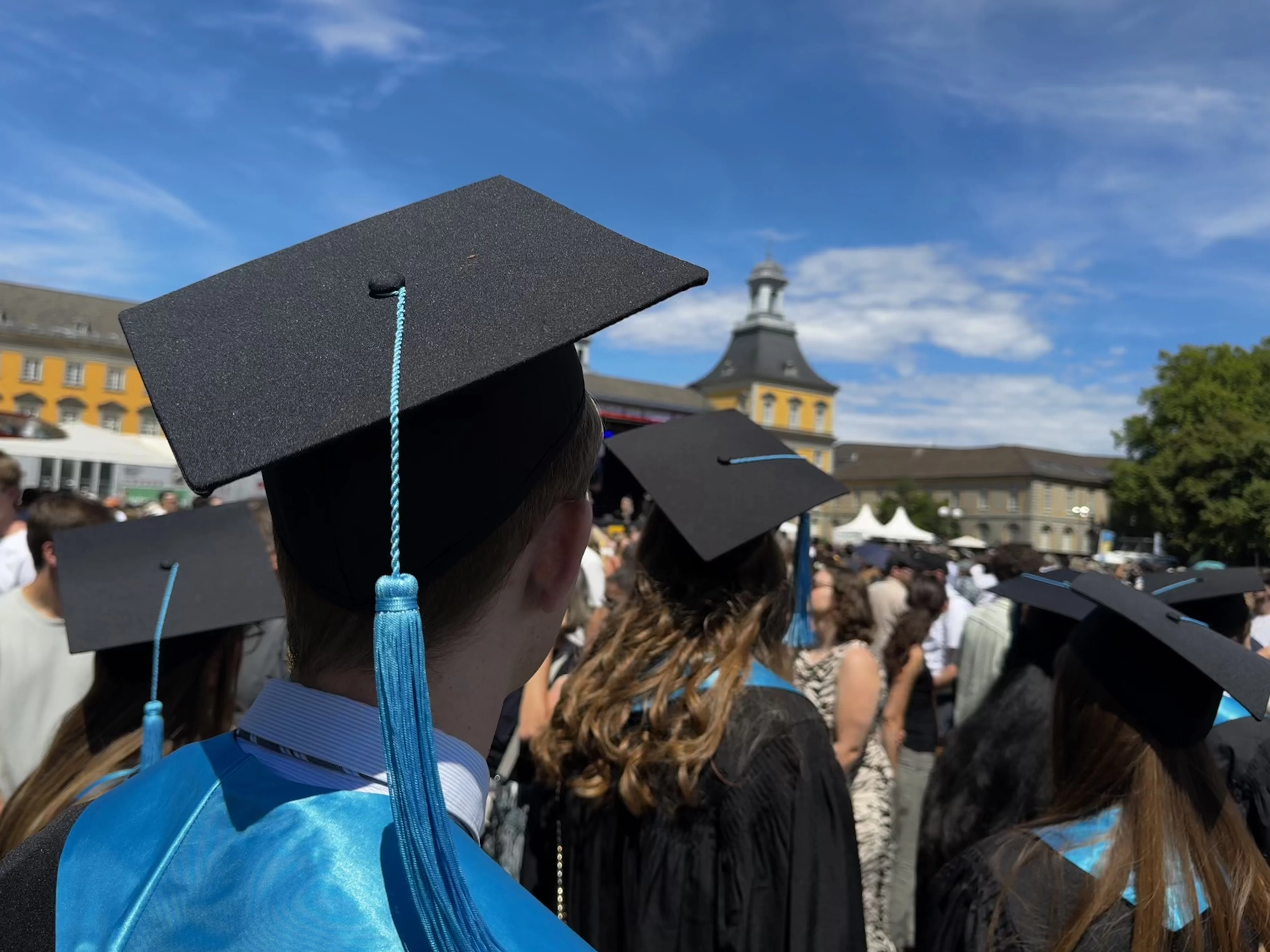
The Bachelor program concludes with a Bachelor thesis, which can be completed in all meteorology and geophysics working groups in a research-oriented manner. The Bachelor thesis is a scientific paper in which you demonstrate your professional expertise and project management skills.


Registration for Bachelor thesis and topic search
- Once you have achieved 90 ECTS, you can apply for admission to the Bachelor thesis (pdf).
- Search for topics by contacting desired supervisors; independent work and obligation to supervisor is a must.
- Processing time: five months in winter 15 Sep-15 Feb or summer 15 Mar-15 Aug.
- Apply for an extension of the submission date by a maximum of six weeks in consultation with the supervisor by e-mail stating reasons to the examination board.
Submission of Bachelor thesis and colloquium
- The title of the Bachelor thesis will only be recorded upon submission and may therefore differ from the proposed topic.
- Submission of three (3) bound copies and a digital version via Sciebo with a declaration of independent preparation (LaTeX-template (tex-file), pdf-preview) to the examination office (Daniela Domgörgen) by the deadline.
- The digital version of the thesis must be submitted on the submission date as a PDF via Sciebo approval/link. Upload the PDF to Sciebo and share the file with the Examination Office, or create a link to the file and send the link to the Examination Office. Test in advance whether the file can be opened via the link.
- Before submission, a 30-minute presentation must be given in the Bachelor colloquium (and others within the working group). Appointments are scheduled centrally.
Assessment and final certificate
- Thesis comprises 12 ECTS; grade is the arithmetic mean of the grades of both supervisors. The evaluation will take 6 weeks.
- Upon request, you will receive a certificate of provisional Bachelor degree completion as soon as all grades have been confirmed by the examiners as at least passed.
- Once all examinations have been completed, the final documents will be issued. The signature process takes a further 3 weeks. The documents must be collected in person from the Examination Office.
The Bachelor program in meteorology and geophysics offers several opportunities to replace the coursework and examinations specified in the study plan with recognized equivalents. Modules completed as part of an Erasmus+ semester abroad or during previous studies will be credited upon request if they are deemed equivalent. It is mandatory to consult with the academic advising office in this regard.
Studying internationally with Erasmus+
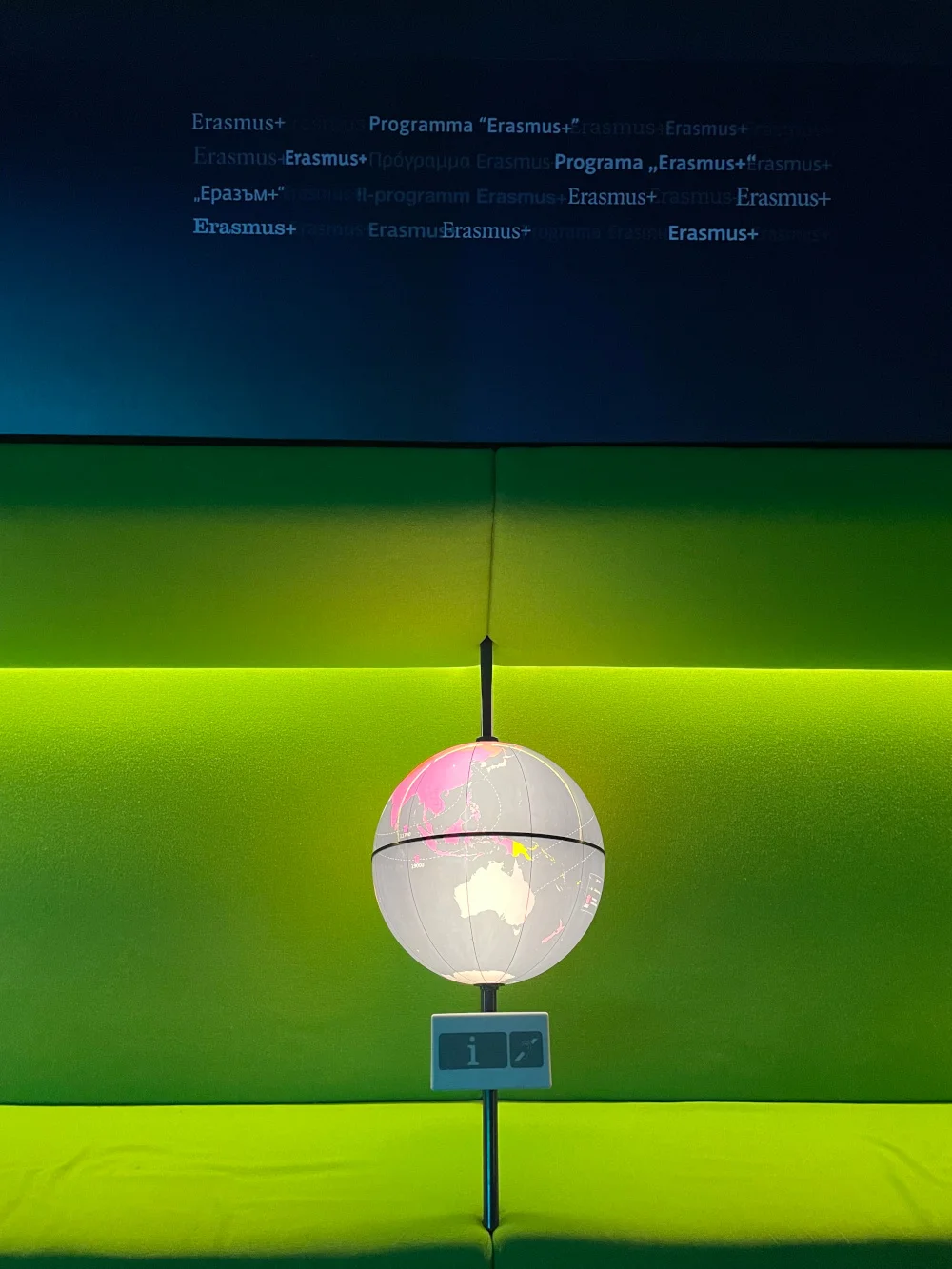
Within the degree programs in Meteorology and Geophysics at the Geoscience Institute, there is the possibility of receiving funding for a maximum of two semesters to study abroad through the European ERASMUS+ program. There are interinstitutional agreements with universities in Europe that offer degree programs in meteorology, geophysics or atmospheric physics.
You can find out everything you need to know about Erasmus+ and other opportunities to study abroad on our subject-specific Erasmus website and on the Erasmus university coordination website.

Recognition of academic achievements
Customizing your studies is possible within the legal framework of the examination regulations.
Supraregional studies: ABC/J
The Geoverbund ABC/J is the geosciences network in the Aachen-Bonn-Cologne/Jülich research region. There is a broad and complementary range of geoscientific degree programs with jointly usable courses, which opens up a wide range of opportunities for students to develop their individual profiles.
If you would like to take modules for the BSc. MuG or MSc. PEA in Cologne or Aachen, please contact the student advisory in advance.
Students from Cologne and Aachen: our modules in the BSc. MuG and MSc. PEA are subject to availability. Please contact us!
Recognition of examination results
If you have completed academic examinations as part of previous studies at another university or in another degree program, these can be credited toward the modules or partial examinations of the Bachelor of Meteorology and Geophysics program upon application, provided they are deemed equivalent. Please consult the Student Advisory Service before submitting your application.
The contents of meteorology and geophysics are exciting and attractive elective courses — we welcome students from other degree programs, who can choose from a variety of courses as elective modules and also select them for their final thesis in the MuG Bachelor degree program.
Modules offered for other Bachelor degree programs
If meteorology and geophysics are available as elective modules within your degree program, you can choose from the following options. There is no registration required; simply attend the classes and join the eCampus courses. Dates, times, locations, and links to eCampus can be found in BASIS.
- Frequency: Winter semester
- Events: Lecture 2 SWS with exercise 2 SWS
- Coursework: Homework
- Examination format: 2 exams worth 3 ECTS each, totaling 6 ECTS
- Prerequisites: Good knowledge of mathematics
Possible for geosciences (BW36), physics, geography, mathematics, computer science, cyber security, geodesy, chemistry, economics
- Frequency: Winter semester or summer semester
- Events: Seminar 2 SWS
- Coursework: Attendance
- Examination format: Seminar presentation and paper worth 2 ECTS
- Prerequisites: Parallel enrollment in one of the other modules
Possible for Physics (Bachelor's and teaching degree)
Mathematics, Computer Science, Cyber Security, Geodesy, Chemistry, Economics
- Frequency: Summer semester
- Events: Lecture 2 SWS with seminar 1 SWS and exercise 1 SWS
- Course requirements: Attendance at seminar and seminar presentation
- Examination format: Oral examination (written examination for large groups) with 6 ECTS
- Prerequisites: Good English skills
Available for physics, geography, mathematics, computer science, cyber security, geodesy, chemistry, economics
- Frequency: Summer semester
- Events: Lecture 2 SWS with exercise 2 SWS
- Coursework: Homework
- Examination format: Written exam with 6 ECTS
- Prerequisites: Very good knowledge of mathematics
Possible for geosciences (BW46, plus mathematics supplement), physics, geography, mathematics, computer science, cyber security, geodesy, chemistry
- Frequency: Winter semester
- Events: Lecture 2 SWS with exercise 2 SWS
- Coursework: Attendance in exercises and homework
- Examination format: Written exam with 6 ECTS
- Prerequisites: Knowledge of Python
Possible for mathematics, computer science, cyber security, geodesy
- Frequency: Winter semester
- Events: Lecture 2 SWS with exercise 2 SWS
- Coursework: Homework
- Examination format: Written exam with 6 ECTS
- Prerequisites: Very good math skills, mug110 recommended
Possible for physics, geography, mathematics, computer science, cyber security, geodesy, chemistry
- Frequency: Summer semester
- Events: Lecture 2 SWS with seminar 2 SWS and exercise 2 SWS
- Coursework: Attendance at seminars and homework
- Examination format: Seminar presentation 2 ECTS and written exam 6 ECTS = 8 ECTS
- Prerequisites: Very good knowledge of mathematics, mug320 recommended
Possible for mathematics, computer science, cyber security, economics
- Frequency: Winter semester
- Events: Lecture 2 SWS with exercise 2 SWS and field exercise 3 days
- Course requirements: Attendance at exercises and field exercises, and homework
- Examination format: Project work (presentation and written report) for 8 ECTS
- Prerequisites: BNP22, BNP23, BNW25, BNW26, BW36, knowledge of Python
Possible for geosciences (BW56)
- Frequency: Winter semester or summer semester
- Events: Working group seminar and colloquium
- Coursework: Presentations in working group and colloquium
Examination format: Bachelor's thesis according to your PO for 12 ECTS - Prerequisites: Contact our professors at least one semester in advance to discuss additional module enrollment—we look forward to hearing from you!
Possible for geosciences (Geophysics specialization) and physics
Degree programs with MuG as elective modules
Your respective examination regulations determine whether you are permitted to complete the meteorology and geophysics modules in your free elective area. There is no registration required; simply attend the lectures and join the eCampus courses. Dates, times, locations, and links to eCampus can be found in BASIS.
- mug110 Introduction to Meteorology and Geophysics 6 ECTS (BW36)
- mug220 Physics of Solid Earth 6 ECTS with mathematical supplement 2 ECTS (BW46)
- mug510 Geophysical Data Science and Field Work 8 ECTS (BW56)
- mug110 Introduction to Meteorology and Geophysics 6 ECTS
- mug111 Introductory Seminar in Meteorology and Geophysics 2 ECTS
- mug210 Physical Climatology 6 ECTS
- mug220 Physics of Solid Earth 6 ECTS
- mug320 Physics of the Atmosphere 6 ECTS
- mug110 Introduction to Meteorology and Geophysics 6 ECTS
- mug210 Physical Climatology 6 ECTS
- mug220 Physics of Solid Earth 6 ECTS
- mug320 Physics of the Atmosphere 6 ECTS
- mug410 Synoptics and Weather Review 8 ECTS
- mug110 Einführung in die Meteorologie und Geophysik 6 ECTS
- mug210 Physikalische Klimatologie 6 ECTS
- mug220 Physik der festen Erde 6 ECTS
- mug310 Remote sensing with Python 6 ECTS
- mug320 Physics of the Atmosphere 6 ECTS
- mug410 Synoptics and Weather Review 8 ECTS
- mug110 Einführung in die Meteorologie und Geophysik 6 ECTS
- mug210 Physikalische Klimatologie 6 ECTS
- mug220 Physik der festen Erde 6 ECTS
- mug320 Physik der Atmosphäre 6 ECTS
- mug110 Einführung in die Meteorologie und Geophysik 6 ECTS
- mug210 Physikalische Klimatologie 6 ECTS
- mug220 Physik der festen Erde 6 ECTS
- mug320 Physik der Atmosphäre 6 ECTS
- mug110 Einführung in die Meteorologie und Geophysik 6 ECTS
- mug210 Physikalische Klimatologie 6 ECTS
- mug220 Physik der festen Erde 6 ECTS
- mug310 Fernerkundung 6 ECTS
- mug320 Physik der Atmosphäre 6 ECTS
- mug110 Einführung in die Meteorologie und Geophysik 6 ECTS
- mug210 Physikalische Klimatologie 6 ECTS
- mug410 Synoptik und Wetterbesprechung 8 ECTS
The responsible examination office for Meteorology and Geophysics and the study advisory are happy to assist you. Office opening hours (blue) and consultation hours (yellow) can be found at https://www.ifgeo.uni-bonn.de/sprechstunde-mug.
Examination office Meteorology and Geophysics

Daniela Domgörgen
2.009
Meckenheimer Allee 176
53115 Bonn
Study advisory Meteorology and Geophysics

Dr. Anna Zoporowski
2.010
Meckenheimer Allee 176
53115 Bonn
Joint examination board for the Bachelor program Meteorology and Geophysics and the Master program Physics of the Earth and Atmosphere
Chair: Prof. Dr. Marcel Thielmann
Deputy chair: Prof. Dr. Leonie Esters
Professors (deputy): Prof. Dr. Andreas Kemna, Vert.-Prof. Dr. Christoph Renkl (Prof. Dr. Ambre Luguet, Prof. Dr. Stefan Kollet)
Academic staff (deputy): Priv.-Doz. Dr. Petra Friederichs (Dr. Maximilian Weigand)
Students (deputy): Erik Brune (Johanna Kasischke)
Meteorology and Geophysics student council
Institute of Geosciences |
Meteorology and Geophysics
Auf dem Hügel 20 | 53121 Bonn | room U1.012
www: https://fsmug.uni-bonn.de
E-Mail: fsmug@uni-bonn.de
Evaluation project group
Evaluation chair (deputy): Prof. Dr. Leonie Esters (Dr. Anna Zoporowski)
Professors (deputy): Prof. Dr. Leonie Esters (Prof. Dr. Andreas Kemna)
Academic staff (deputy): Dr. Maximilian Weigand (Dr. Svenja Szemkus)
Study program manager: Dr. Anna Zoporowski
Students (deputy): Johanna Kasischke, Yannick Szlapka (Helene Schüßler, Alex Kiddle)
QVM committee
Prof. Dr. Andreas Kemna
Prof. Dr. Leonie Esters
Students: Johanna Kasischke, Erik Brune