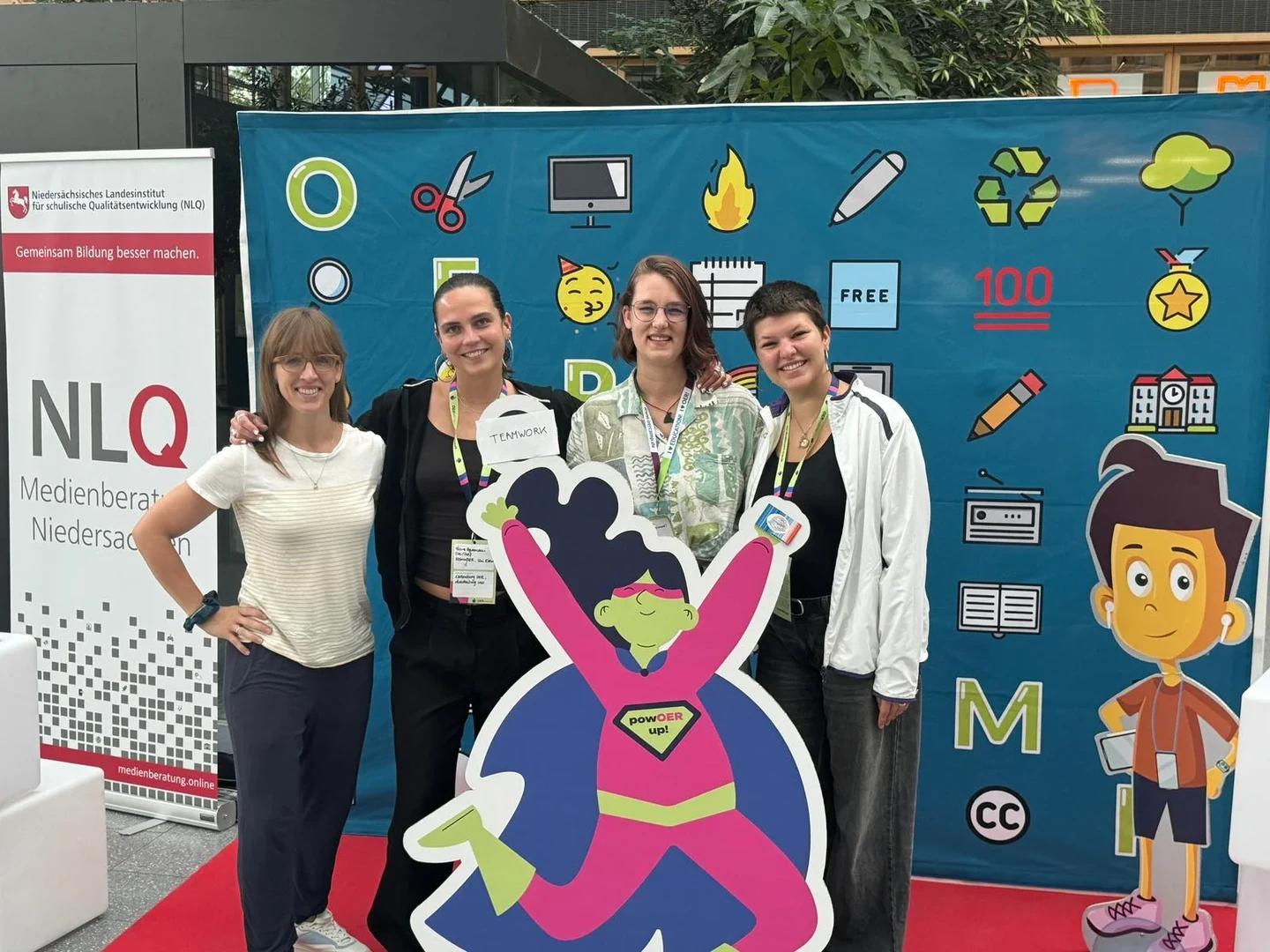
It was that time again – from 4 to 6 September, the OERcamp took place, this time in Hannover. For us, it was a good time to recap where we stood at the last OERcamp. The main focus here was on exchange and creating an overview of the sometimes somewhat diffuse OER concept, gathering input for our workshops and ideas for our best practice example. Anyone involved in the OER landscape knows that these approaches never stop. However, we had two other things in focus for this OERcamp. Together with Sonja Philipp (OE_com Project Ombrella), our project coordinator Ellen took on the eternal question of how we define the term Open Educational Practices (OEP) in a ‘Open Edu What? - Pre-Workshop’. In addition, with our best practice example, which we have been working on for several months, we hoped to receive feedback from people in the community.
Thursday morning began with the pre-workshop, even before the official start of the camp. The aim of the workshop was to bring some order to the concept of OER by critiquing, expanding and improving the overview provided by the English Wikipedia entry on OER. The processes involved were particularly exciting: initial reformist ideas developed into almost revolutionary changes to the graphic. The results will be published in german on the OER World Map in due course. The workshop concluded with the task of pitching a self-created OEP persona and its benefits. Particularly impressive was the pitch to an alien who lands on Earth and whose spaceship has broken down. It turned out that OEP proves its worth here too, because even a spaceship can be repaired through the community aspect.
After the camp was officially opened, there was a rally and other smaller programme items. The evening concluded with a stage discussion with climate researcher, aspiring astronaut, local politician and initiator of our KlimaOER project, Dr Insa Thiele-Eich. She gave an impressive account of how she juggles her numerous vocations with her desire to make the world a better place and reported on her efforts to make conferences (more) accessible to people with children.
On day two, the famous Barcamp sessions of the OERcamp began. Here, each participant has the opportunity to offer a session. Whether a session is used to discuss unresolved questions, provide input or work something out together is up to the participants themselves. We used the Barcamp format to offer a session in which we presented our best practice example on the topic of wind. The participants were asked to work through the module, come to us with any questions and then share their impressions with us. This exchange was extremely productive and helpful for us. Discrepancies, comments on the central theme or difficulties in understanding, which we no longer notice due to our constant work on the module, helped us to improve our module. Here, too, it became clear how the OEP concept also proves its worth in work formats and can lead to a change of perspective.
The rest of the camp was mainly devoted to exchanges with the community. Overall, participation in the OERcamp was once again an enriching opportunity for KlimaOER to network and learn.